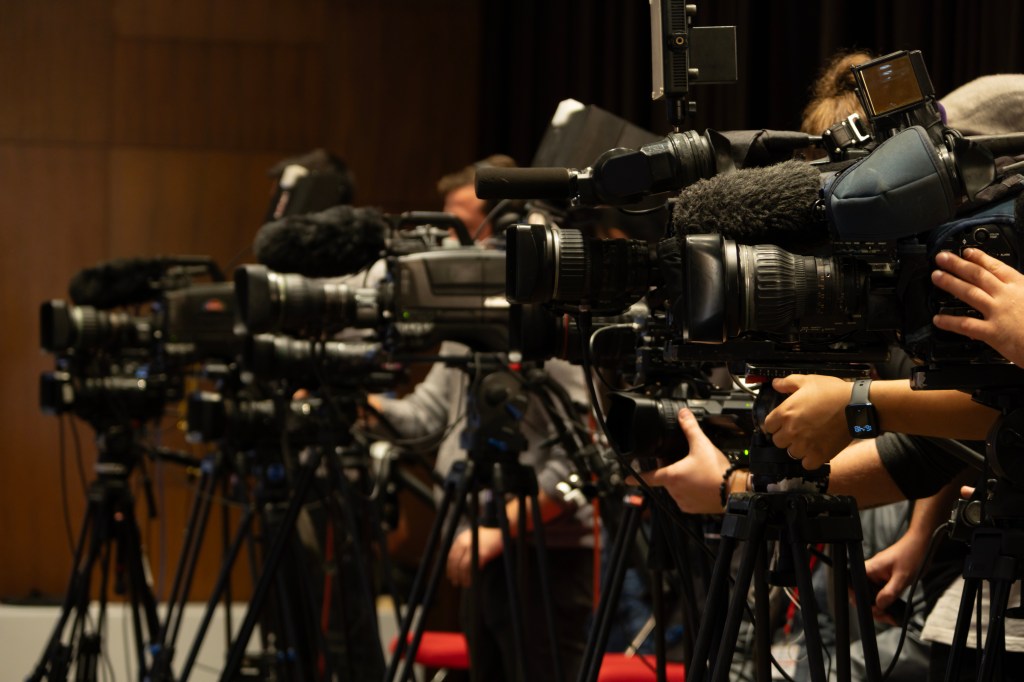
Photo Credit: Professional video cameras on tripods recording a corporate press conference / Batuhan Toker
Research, audience ratings and social media activity reveal how Americans engage with political news and information overload.
More than half of U.S. adults say they feel worn out by the amount of news, while research on online discussion surrounding the 2026 midterm elections found that fear and other negative emotions dominated political conversation.
Research Shows Widespread News Fatigue
A February 2026 survey by the Pew Research Center found that 52% of U.S adults felt worn out by the amount of news. The survey of 3,560 adults, conducted December 8-14, 2025, also found that 48% considered most news they encountered irrelevant to their lives and 60% had reduced their news consumption. The findings measure general news habits, not attitudes specifically toward election coverage.
A Montclair State University study examined more than 1.69 million online mentions related to the 2026 midterm elections. Researchers reported that fear accounted for 51% of election-related discussions and negative emotions represented 93% of the analyzed conversation. The university said researchers also examined 35,000 Trump-related posts on X. The findings describe online discussion, not a representative measure of voter’s opinions or emotional states.
Audience Ratings and Election Coverage
Television ratings offered another measure of audience behavior. The Financial Times reported that Fox News’ prime-time audience declined 28% year over year in October, while its total-day audience fell 27%, citing Nielsen data. Fox Corp. Chief Executive Lachlan Murdoch attributed the decline partly to “viewer fatigue.” His explanation is an attributed assessment, not proof of why viewers watched less.
Vermont Public’s Nov. 2 “Vermont Edition” broadcast discussed political anxiety and election fatigue with Middlebury College professor Bill McKibben and Dr. Steven Scholzman, chief of child and adolescent psychiatry at the University of Vermont Health Network. The outlet described campaign messages, attack advertisements and continuous headlines as potential sources of strain for adults and children.
Psychological Research on News Overload
The American Psychological Association’s “Speaking of Psychology” episode, “How to cope with news overload,” featured University of Wisconsin-Madison psychology professor Markus Brauer and media psychologist Don Grant. Brauer discussed a 2021 study he co-authored that found COVID-19 information seeking associated with emotional distress. Television and social media news use was also associated with greater distress, while newspaper use was not significantly associated with it. The researchers cautioned that the study could not establish cause and effect.
Together, the sources show that news fatigue is widespread and online midterm discussion contained high levels of negative emotion. They do not establish that election coverage caused news fatigue or that online activity represents the broader public.

